Vehicle Keypoints
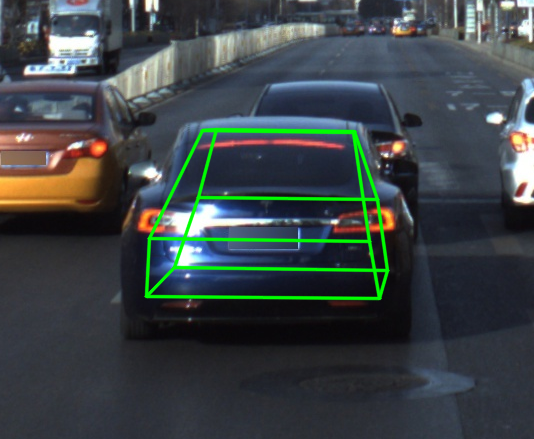
An example from the geometric PnP baseline; see the protocol and limitations.
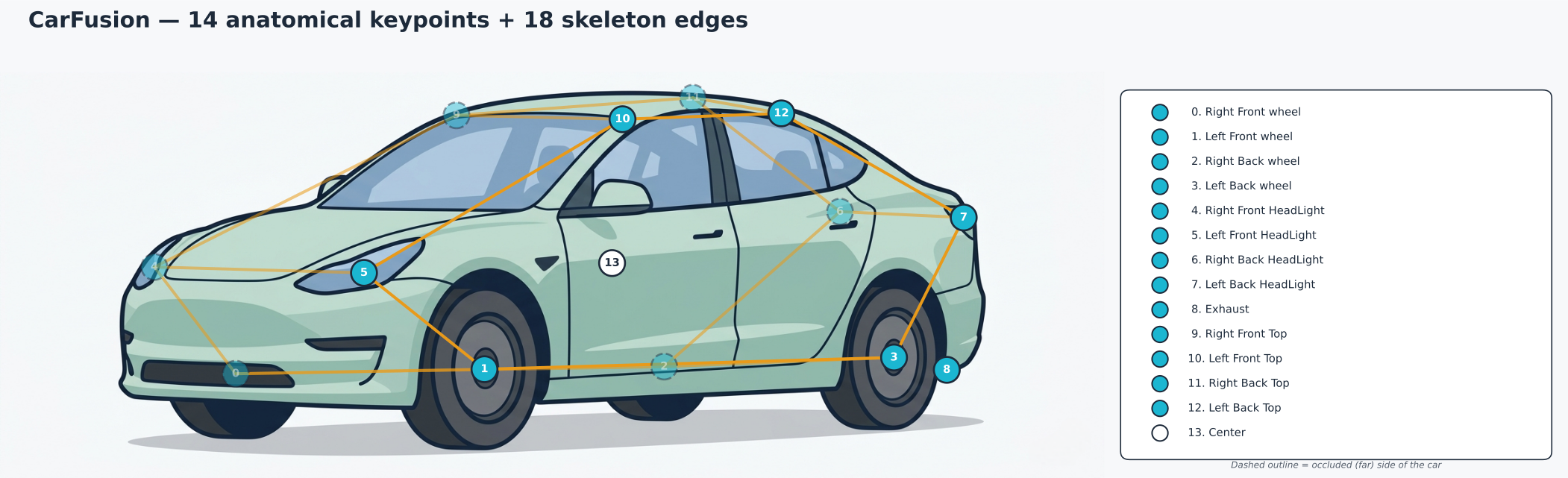
Research toolkit for 14-keypoint vehicle pose estimation on the CarFusion (CMU) dataset - four wheels, four head- and tail-lights, four roof corners, the exhaust, and a body-centre reference point per car.
Results and research
The main detector's published CarFusion evaluation and baseline caveats are documented in the usage and evaluation guide. The 3D reconstruction example uses ApolloCar3D and has a separate evaluation protocol.
The synthetic-data experiment is complete: the tested synthetic supplement did not meet the +2 pp OKS-mAP criterion. Its contribution was -1.7 pp from the weak checkpoint and -9.5 pp from the strong one. The report distinguishes this negative result from the gain caused by correcting horizontal-flip keypoint labels.
Task
Per-vehicle 2D landmark localisation on RGB images. 14 anatomical keypoints per car instance follow the original CarFusion (Reddy et al., CVPR 2018) schema: 4 wheels (front/rear × left/right), 4 head- and tail-lights (front/rear × left/right), 4 roof corners (front/rear × left/right), the exhaust, and a body-centre reference point. Each keypoint carries an (x, y, v) triplet where v ∈ {0, 1, 2} (absent / occluded / visible) following the COCO convention.
Models
- Main - YOLO26-pose (Ultralytics 8.x). Anchor-free single-shot detector + keypoint head; non-human-keypoint-friendly, high throughput, standard
.ptexport. - Baseline - ViTPose-S (HF
transformers5.x, Lightning-wrapped). Top-down (crop → heatmap) transformer; pretrained on COCO human 17-kpt, re-headed to 14 car keypoints.
Stack
Python 3.13 · uv (cu124 torch wheels) · Ultralytics 8.x · transformers 5.x · PyTorch Lightning · Hydra · MLflow (ViTPose branch) · FastAPI · Docker · MkDocs Material · GitHub Actions.
Navigation
- Usage and evaluation - quick start, dataset, API examples, 2D and 3D protocols
- Synthetic-data experiment - matched ablations and error analysis
- Architecture - data flow, two-branch pipeline, metric choices
- Training - YOLO + ViTPose commands, Hydra overrides, GPU notes
- Serving - FastAPI
/detect, Docker, JSON + PNG overlay responses - Model card - HF Hub card template (Jinja-rendered at publish time)
Links
- Code: https://github.com/kiselyovd/vehicle-keypoints
- Model: https://huggingface.co/kiselyovd/vehicle-keypoints
Intended use
Research and educational artifact demonstrating modern keypoint-detection pipelines on a non-human class. Not intended for any safety-critical, autonomous-driving, or surveillance deployment - the model is trained on a single academic dataset and has not been validated for production use.